Answering the need for quick, reliable CPR support on crash carts and in emergency rooms. These CPR boards are designed to position the patient correctly, provide a firm surface for chest compressions, and make patient handling safer for responders. Best for EMS professionals, hospital staff, and home responders who want portable, durable backboards that improve resuscitation effectiveness. The following picks represent a mix of professional-grade and portable boards, focusing on clearance of airway, stability, and ease of use.
Summary of selected products
| Product | Best For | Key Benefit |
|---|---|---|
| LINE2design CPR Rescue Lifesaver Board | Professional EMS and home use | Anatomically contoured with recessed handles for easy lifting |
| HaiChao CPR Rescue Lifesaver Board | All care settings requiring rigid, flat backboard | Rigid surface with easy slide-under design |
| CPR Board & Cardiac Backboard – MERGENCY | Hospitals, crash carts, training | Hospital-grade polypropylene with head alignment cup |
| Kemp USA Medical CPR Board | Training and controlled environments | Head cup alignment; contoured sides for lifting |
| EMS XTRM CPR Board | EMS, lifeguards, first responders | Lightweight with recessed handles for easy lifting |
LINE2design CPR Rescue Lifesaver Board

Features: Lifesaver CPR Board is anatomically contoured to position the patient for effective application of CPR. Recessed handles help with positioning and lifting. Dimensions: 23.25″ x 17.25″.
Best for: EMS teams and home caregivers who want a sturdy, contoured board with built-in lifting grips. Why selected: Combines anatomical shaping with practical handling features to support rapid CPR deployment.
Caution: Size may be larger for compact hospital carts; verify storage space in your response kit.
HaiChao CPR Rescue Lifesaver Board

Features: A rigid plastic backboard designed to slide under an immobile patient. Includes simple, effective design with solid hand grips. Easy to clean and maintain; hospital-grade plastic; lightweight for transport.
Best for: Settings needing a dependable, rigid backboard to maintain airway position during CPR. Why selected: Clear emphasis on proper airway alignment and quick under-patient insertion.
Caution: Some users may prefer boards with integrated head cups for airway control in large patient populations.
CPR Board & Cardiac Backboard – MERGENCY

Features: Thick, hospital-grade polypropylene with recessed head cup for precise head positioning. Contoured to fit a wide range of body sizes, ensuring effective CPR administration.
Best for: Hospitals, crash carts, and training facilities needing a robust, reliable backboard. Why selected: Emphasizes airway alignment and stability for consistent chest compressions.
Caution: Higher rigidity can be less comfortable for long-duration transport in some scenarios; consider padding needs where relevant.
Kemp USA Medical CPR Board
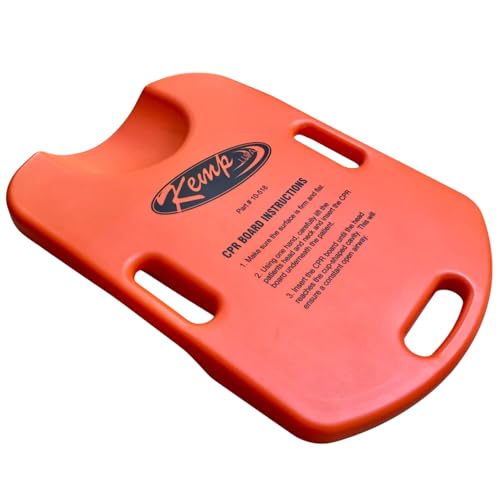
Features: Professional CPR training board built for teaching and emergency response. Head cup alignment supports airway positioning. Contoured sides facilitate lifting and stabilization.
Best for: Training labs and controlled drills, as well as real-world emergency response. Why selected: Combines educational design with practical rescue-ready features.
Caution: Primarily designed for training, so check compatibility with actual clinical use environments if used daily for patient care.
EMS XTRM CPR Board

Features: Lightweight design with recessed handles for easy patient lifting. Durable construction suited for EMS settings and rapid deployment.
Best for: First responders and lifeguards who need a portable, durable board. Why selected: Lightweight, easy to carry while maintaining CPR effectiveness.
Caution: May offer fewer integrated airway aids than some hospital boards; ensure staff are familiar with head positioning on this model.
Beiruoyu and similar boards
Note: Several additional boards in this category emphasize quality materials, recessed handles, and contouring for quick CPR. If you need more options beyond the five highlighted, consider models with head cups, hospital-grade plastic, and compatibility with crash carts to match your exact setting.
Buying Guide
What to consider when choosing a CPR backboard for crash carts and emergency care
- Material and durability: Hospital-grade polypropylene or comparable plastics offer stability and cleanability. Choose boards that resist deformation under chest compressions.
- Head positioning: A head cup or contoured front helps maintain airway alignment during CPR. If airway control is critical in your setting, prioritize this feature.
- Size and portability: Larger boards provide more surface area but require storage space. Weigh needs for cart attachment, hallway movement, and patient size.
- Handles and lifting: Recessed handles reduce strain on responders and improve maneuverability during loading and patient transfer.
- Cleanability and maintenance: Boards should be easy to wipe down and sanitize between patients. Smooth surfaces help with infection control.
- Training vs. real-world use: Training boards are valuable for drills, but ensure the model you select supports actual CPR administration if used in real care scenarios.
- Compatibility with crash carts: If you must attach or slide boards onto carts, verify dimensions and mounting options before purchase.
FAQ
- What is the main purpose of a CPR backboard?
To provide a flat, stable surface under the patient so chest compressions are effective and airway management is easier. - Should I choose a board with a head cup?
Yes, if airway alignment is a priority or if responders frequently reposition the head during CPR. - Are lightweight boards less durable?
Not necessarily; many lightweight boards use strong materials that withstand repeated use, but verify applicable durability claims for your setting. - Can these boards be used for training?
Yes, most are suitable for training and real patient care; consider models designed for both purposes. - What maintenance is required?
Regular cleaning with approved sanitizers and inspection for cracks or warping after heavy use. - How do I choose the right size?
Consider typical patient sizes, storage space, and whether boards will be mounted on carts or stored in cabinets.