Answering the search for a reliable digital clock for seniors with dementia, these devices emphasize large displays, clear date and day indicators, and simple reminders. They are best for caregivers seeking straightforward visual prompts, memory support, and medication or daily-activity reminders for loved ones. The featured models range from 7-inch to 12-inch screens, with adjustable brightness, multiple alarms, and DST auto-adjustments to help reduce confusion and improve daily routines.
Buying considerations at a glance: the top five options below offer prominent, high-contrast displays; intuitive layouts that show time, date, and day of week; multiple alarms and reminders; and configurable brightness. The selection aims to cover different room sizes, accessibility needs, and reminder complexity. Use the quick-reference table to compare size, alarm capacity, and standout features before reading deeper product notes.
| Product | Display Size | Alarms / Reminders | Best For |
|---|---|---|---|
| Roxicosly 7″ Day & Date Clock | 7 inches | 20 alarms, 20 reminders | Compact rooms, simple daily routines |
| Mitoart Digital Alarm Clock | 7 inches | Multiple alarms, reminders | Voice-announced time, dementia support |
| Roxicosly White 7″ Clock | 7 inches | 20 alarms, 20 reminders | Clear day/week display, cognitive support |
| Soobest 12″ Dementia Clock | 12 inches | 20 alarms, 20 reminders | Distance visibility, memory aids |
| FLYRUIT 7″ Dementia Clock | 7 inches | 6 alarms, 10 reminders | Visual icons, flexible tones |
Roxicosly Clock With Day And Date For Elderly

The Roxicosly 7-inch clock provides a large 1024×600 HD display showing time, date, day of the week, six daily time periods, and vivid day/night icons. It supports up to 20 standard alarms and 20 reminders, including medicine and hydration cues. The top-level controls enable a one-touch sleep mode and 10 brightness levels, letting caregivers tailor brightness to day or night. This model is best for caregivers needing detailed daily prompts in a compact unit.
Best for: seniors who benefit from visible day segments and multiple reminders in a small space. Why selected: its combination of large, high-contrast display and extensive reminder options supports memory tasks and routine adherence. Caution: the clock relies on AC power; ensure a stable outlet to prevent data loss in the event of a power outage.
Mitoart Digital Alarm Clock With Date And Day

The Mitoart clock emphasizes voice announcement of time in nine languages, assisting seniors with limited vision. It offers multiple alarms and reminders for medications and schedules, plus auto-daylight awareness. The 7-inch display presents week, month, and date with a straightforward interface for dementia or memory-impaired users. This option is best for those who value spoken time cues and multilingual support.
Best for: seniors who benefit from audible time cues and multilingual accessibility. Why selected: voice timing reduces reliance on visual cues and supports users with varying levels of vision. Caution: ensure batteries or a power source compatible with the device since power disturbances may interrupt settings.
Roxicosly Digital Clock With Date And Week (White)

This white, 7-inch Roxicosly model presents a large display that clearly shows time, date, and the day of the week with seven time segments and SUN/MOON icons. It includes up to 20 alarms and 20 reminders for medication and important tasks. The device notes include a power adapter requirement to prevent setting resets during outages. Best for: rooms where a brighter, pure-white aesthetic helps readability. Why selected: consistent layout with a robust alarm/reminder suite makes daily planning reliable. Limitation: power adapter is required for full function; battery backup only stores settings.
SSYA Digital Calendar Alarm Clock For Dementia

The SSYA model features a 7-inch HD LCD with non-abbreviated date and day readouts. It’s designed for easy plug-and-play setup and can be wall-mounted or placed on a table. Auto night dimming helps reduce glare in dark rooms, with five brightness levels available. This clock is best for caregivers who value a simple, dimmable display with a straightforward time-date-day layout.
Best for: seniors who prefer a simplified, glare-free screen with flexible placement. Why selected: auto-dimming reduces nighttime disturbance, enhancing comfort. Caution: the device emphasizes a non-abstract display; some users may still require larger font alternatives depending on visual needs.
Soobest Dementia Clock With 20 Alarms

The Soobest clock offers a seven-inch HD display with up to 20 alarms and 20 reminders. It features three sound options and adjustable volume, plus multiple display modes including white and color backgrounds. This model is ideal for families needing a rich reminder system with flexible audio cues and memory-supporting visuals. Best for: seniors who benefit from varied reminders and customizable sounds. Caution: some users may prefer larger screens for easier reading at a distance.
Soobest 12” Dementia Clock For Seniors
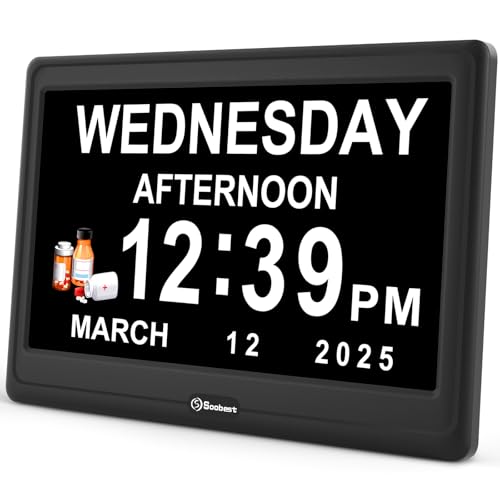
The 12-inch Soobest clock delivers a larger display for distant viewing, with 20 alarms and 20 reminders, plus options for display modes including white and yellow digits or an analog clock face. Its dual-level reminder system supports daily, weekly, or date-specific tasks. Best for: rooms where distance viewing is essential. Why selected: the larger screen improves readability for vision-impaired seniors. Caution: larger unit requires more space and power considerations.
Buying Guide: Key Considerations For Choosing A Dementia Clock
- Display clarity: Look for 7- to 12-inch screens with large, high-contrast numerals and explicit day-of-week labeling. Avoid abbreviations if possible.
- Reminders and alarms: Confirm the maximum number of alarms and reminders, and whether they can be set for specific dates or recurring schedules.
- Brightness and lighting: Prefer devices with adjustable brightness and auto-dimming to minimize nighttime disturbance while maintaining readability.
- Power and durability: Check whether the clock uses AC power, battery backup, or both. Consider reliability during outages and whether settings persist without power.
- Ease of setup: Choose models with simple plug-and-play operation and clear user manuals suitable for caregivers and seniors.
- Verbosity and accessibility: Some models include voice announcements or multilingual support, which can aid users with limited vision or language needs.
- Placement flexibility: Wall-mountable or table-top options can influence which room the clock best fits in (bedroom, living area, or kitchen).
Frequently Asked Questions
- What makes a dementia clock better for seniors? A high-contrast display, clear time/date layout, and reliable reminders help reduce confusion and support daily routines.
- How many alarms should a dementia clock have? Five to twenty alarms is common; select based on how many daily reminders are needed for medications, meals, or activities.
- Is a voice announcement feature useful? Yes, it helps users who have difficulty reading small text, especially when vision is impaired.
- Should I prioritize larger screens over more features? Larger screens aid readability at a distance; however, more alarms and reminders provide greater daily support. Choose based on the user’s specific needs.
- Do all clocks require an internet connection? Most reviewed models operate offline; they rely on internal clock settings and power to function effectively.