Answering the common buyer question: which disposable cuvettes deliver reliable, repeatable absorbance readings across standard spectrophotometers? This guide features five well-suited options for different lab needs, from high-volume testing to precise measurements. Best for classrooms and basic research, better for routine assays, and choose this if you need value and convenience in one package. The products highlighted below are selected for optical clarity, standard pathlength, and practical designs that minimize measurement variability.
| Product | Best For | Approx. Capacity | Key Benefit |
|---|---|---|---|
| Fiwochic 100 PCS | General labs | 2.5–4.5 ml | Clear two-sided observation, reliable 340–750 nm transmission |
| LemonRoad 500 Pcs 4.5 ml | High-throughput testing | 4.5 ml | Four-sided visibility, easy orientation, disposable for speed |
| Starry 100 Pcs 4.5 ml | Routine spectrophotometry | 4.5 ml | Two smooth sides for accurate transmission |
| LAB4US 100 Pcs 2.5–4.5 ml | Academic labs | 2.5–4.5 ml | Wide spectral range, clear material and lid |
| Globe Scientific 111137 | Batch analyses | 4.5 ml | Four-sided design, broad wavelength applicability 340–800 nm |
Fiwochic 100 PCS Polystyrene Cuvettes

These cuvettes are made from polystyrene and sold in a 100-piece pack with a foam container. They offer transparent, bubble-free walls and two clear sides for easy visual inspection. With a pathlength suitable for most standard spectrophotometry needs, they cover 2.5–4.5 ml volumes and a visible transmission range of 340–750 nm. Best for routine experiments in teaching labs or small-scale research where straightforward, economical cuvettes are preferred.
Who it’s best for: educators, students, and small labs needing bulk disposables without specialized features. Why selected: strong optical clarity and dual observation surfaces support reliable qualitative checks and basic quantitative work. Caution: ensure consistent orientation when loading into the instrument, as slight manufacturing variation can affect alignment.
LemonRoad 500 Pcs 4.5ml Cuvettes

This bulk option uses polystyrene for clear light transmission across a 340–800 nm band. Each cuvette holds 4.5 ml, with a standard 10 mm pathlength, making it suitable for many absorbance measurements. The design includes a mark to indicate the direction of transmission, helping reduce measurement variability due to orientation. Ideal for high-volume testing where consistent results are required across many samples.
Who it’s best for: labs performing frequent batch tests and routine spectrophotometry. Why selected: high-volume value with reliable optical performance. Caution: disposable use means plan for steady supply to avoid gaps in workflow.
LemonRoad 200 Pcs 1.5ml Cuvettes
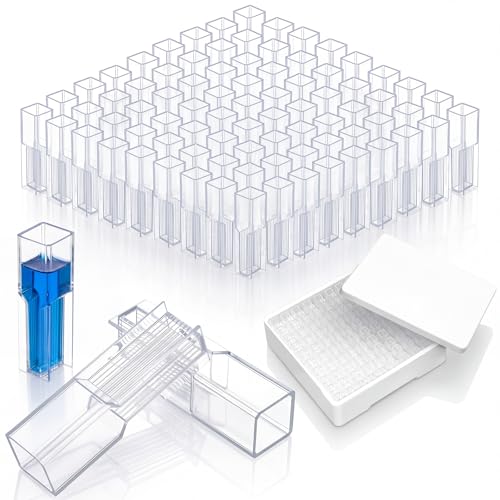
These 1.5 ml polystyrene cuvettes emphasize a practical orientation indicator in a compact form. The standard 10 mm pathlength supports measurements across 340–750 nm and ensures compatibility with common spectrophotometers. The two orientation marks help ensure a consistent beam path, which is especially helpful in teaching and routine analyses where space is limited.
Who it’s best for: smaller sample analyses and classrooms where volume is constrained. Why selected: compact size with clear orientation guidance. Caution: lower volume may limit certain micro-volume experiments.
Globe Scientific 111137 Cuvette Set
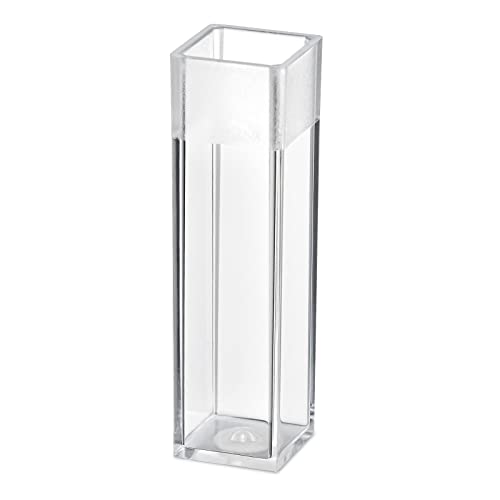
This set features a four-sided, polystyrene design with 4.5 mL capacity. It targets broad spectral usage from 340 to 800 nm, with emphasis on high reproducibility and a tight manufacturing tolerance essential for batch analyses. The four-wall design minimizes light leakage and improves measurement consistency across samples.
Who it’s best for: labs conducting batch testing and standardized analyses. Why selected: durable four-sided geometry supports uniform readings and versatility across common assays. Caution: batch consistency is crucial; verify lot-specific performance for critical experiments.
Buying Guide: Cuvette Choice For Your Spectrophotometer
- Pathlength and volume: Standard pathlength is 10 mm. Choose cuvettes matching your sample volume needs (2.5–4.5 ml options cover most routine tests).
- Material and optical clarity: Polystyrene cuvettes are common for visible-range work (340–750 nm). For UV-heavy work (below 340 nm), consider UV-grade PMMA or quartz options.
- Two vs. four sides: Two-sided cuvettes offer basic transmission viewing; four-sided designs minimize edge effects and improve repeatability in batch testing.
- Orientation features: Marks or V-shaped indicators help align the cuvette with the instrument beam path, reducing measurement variation.
- Disposability vs. reusability: Disposable cuvettes save cleaning time but require ongoing supply. Reusable cuvettes demand careful cleaning and drying to maintain optical quality.
- Compatibility: Ensure the cuvette material and wavelength range align with your spectrophotometer’s illumination and detector capabilities (typical range 340–800 nm for visible analyses).
Frequently Asked Questions
- What pathlength do most cuvettes use? Most standard cuvettes use a 10 mm pathlength, which is compatible with a wide range of absorbance measurements.
- Do I need four-sided cuvettes for basic tests? Four-sided cuvettes can improve measurement consistency in batch analyses, but two-sided cuvettes are acceptable for simple, low-precision experiments.
- Are disposable cuvettes better for teaching labs? Yes. They reduce cross-contamination risk and save time on cleaning, which is advantageous in teaching environments with frequent use.
- Can cuvettes affect reading accuracy? Yes. Fingerprints, scratches, and misalignment can alter transmission readings. Choose design features that minimize handling errors and ensure clean, clear optical surfaces.
- What wavelength range should I consider? For general visible-range work, 340–750 nm is typical. If you need UV capabilities, look for UV-grade materials and a broader range (e.g., 280–800 nm).
- Is it okay to mix brands? Mixing cuvettes from different brands is generally acceptable if the wavelength range and pathlength match your instrument, but be aware of potential small differences in transmission characteristics.