Answering the need for quick help and peace of mind, these devices provide reliable two-way communication, location awareness, and alerts for caregivers and family. This guide highlights five top options suited for different situations, from home environments to mobile use. It helps seniors, family members, and caregivers choose a device that matches daily routines, home layouts, and alert preferences. The table below compares core features to aid quick decisions.
| Product | Best For | Connectivity | Key Benefit |
|---|---|---|---|
| LogicMark Freedom Alert | Home safety for seniors with landline | 2-way landline | Direct 911/personal calls from home |
| PILSAMAS WiFi Caregiver System | Bilevel homes with Wi‑Fi and app alerts | Wi‑Fi + 433MHz | App alerts and location via hub |
| CallToU Wi‑Fi Wireless Caregiver Pager | Families needing shared notifications | Wi‑Fi 2.4GHz | Shared alerts among caregivers |
| Smart Med Alert Necklace | 24/7 monitoring with GPS | Cellular (AT&T 4G LTE) | GPS location and 2-way talk |
| Home & WELLNESS Co. Stride Safety Watch | Wearable with GPS for active seniors | AT&T cellular | Emergency button on a watch form factor |
LogicMark Freedom Alert — Home Safety Pendant with 2-Way Call

Best for seniors who rely on a landline, this device uses existing phone service to create 2-way conversations with EMS or family. It supports direct calls to 911 dispatchers and loved ones, enabling immediate information sharing during emergencies. The pendant design offers wearable access or easy mounting for quick reach.
Who should consider it: a household where a landline is standard and quick emergency dispatch is a priority. Why selected: robust home protection with direct two-way communication that connects to emergency services and family from a single device. Caution: dependent on a functional landline, which may limit use in areas without landline service.
PILSAMAS WiFi Caregiver Pager System

This system blends a hub with a wearable wristband and multiple call buttons. It uses a 2.4 GHz Wi‑Fi backbone for app access and 433 MHz for long-range in-wall alerts, supporting a broader home layout. It clearly identifies who needs help and where, with activity logs and customizable alert tones. Free updates and flexible sharing make it attractive for multi-caregiver households.
Who should consider it: households seeking app-based alerts and multi-user sharing without ongoing subscription. Why selected: strong combination of local alerting, GPS-like clarity in the app, and long-range coverage inside the home. Caution: requires a stable home Wi‑Fi network for full app functionality.
CallToU Wi‑Fi Wireless Caregiver Pager
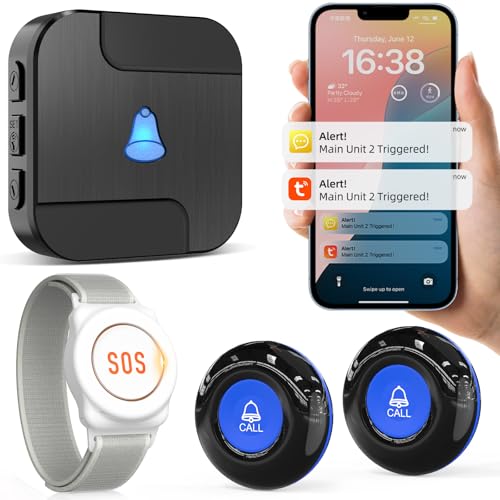
This setup uses 433 MHz for local range and connects to your home Wi‑Fi for global access. Pressing the button triggers a loud alarm and app notification; optional phone or text alerts can be added for a monthly fee. Sharing options let family members receive alerts simultaneously, improving response times in a busy household.
Who should consider it: families needing centralized alerting with opt-in notifications. Why selected: transparent notification flow and flexible sharing. Caution: ongoing notification options may incur monthly fees if chosen.
Smart Med Alert Necklace with 24/7 Monitoring

This wearable pendant provides cellular connectivity with GPS tracking for real-time location sharing with responders. It emphasizes ongoing monitored emergency response and 2-way communication with operators. A subscription is required to enable full monitoring while in use. Spanish-speaking operators can be requested.
Who should consider it: seniors who value continuous monitoring and GPS tracking beyond in-home alerts. Why selected: built-in cellular coverage that does not depend on a landline. Caution: ongoing monthly service fees apply for monitoring.
Stride Medical Alert Watch — GPS and Emergency Button

The Stride Safety Watch bundles GPS tracking with an easy-access emergency button. Designed as a stylish wearable, it blends daily wear with a direct line to live support when activated. It’s suitable for those who want quick, discreet access to aid without a bulky device.
Who should consider it: users who prefer a watch-style device and value location tracking. Why selected: combines phone-like emergency access with GPS for caregiver awareness. Caution: watch-style devices may require regular charging and careful sizing for comfort.
Taiker Personal Alarm Keychain (Bonus)

Although included here as a supplementary option, this 140 dB alarm keychain serves as a quick audible alert for nearby people when immediate help is needed. It pairs with LED lighting for visibility in low-light settings. It’s best used as a secondary safety accessory alongside a primary medical alert system.
Who should consider it: individuals seeking an inexpensive, portable alert that augments primary devices. Why selected: broad visibility and quick audible alerts. Caution: it is not a replacement for a full caregiver alert or medical monitoring system.
Buying Guide: Key Purchase Considerations
- Home vs. on-the-go use: For stationary living spaces, landline-based devices like LogicMark work well. For mobile or multi-room homes, Wi-Fi or cellular options (PILSAMAS, CallToU, Smart Med Alert, Stride) provide broader coverage.
- Connectivity needs: Landline-based devices require existing service; cellular devices work where cell signal exists. Wi‑Fi dependent systems need a stable network with minimal latency for reliable alerts.
- Two-way communication: Prioritize devices that support live conversations with responders or caregivers, not just alerts.
- Location tracking: GPS-enabled wearables help caregivers locate a wearer during emergencies, especially outdoors or in unfamiliar places.
- Subscription and fees: Some devices require ongoing service; others include free updates or optional plans. Consider total cost of ownership beyond upfront price.
- Ease of use: Look for intuitive buttons, clear audible alerts, and simple app interfaces for family members and caregivers.
- Multi-user sharing: In households with multiple caregivers, devices that support alert sharing improve response coordination.
Frequently Asked Questions
- What is the best device for a home with a landline? LogicMark Freedom Alert is well-suited for homes with existing landline service and direct two-way calls.
- Do these devices require a monthly fee? Some options include optional or required subscriptions for monitoring or alert services; others offer free app notifications with optional paid plans.
- Can devices track a senior’s location? Many wearables and some systems provide location data via GPS or network-based positioning for responders.
- Are these devices easy for seniors to use? Most models emphasize simple button access and audible alerts; wearables are designed to resemble watches or pendants for daily wear.
- Can caregivers share alerts with multiple family members? Several systems offer multi-user sharing to notify several caregivers at once.
- What should I consider if I don’t have reliable Wi‑Fi? Rely on cellular or landline-based systems that work independently of Wi‑Fi to maintain consistent access to emergency services.