Answer: For stairs-only evacuations, compact, lightweight, and mechanically simple chairs excel. The top picks below balance load capacity, foldability, and safety features to suit EMS teams, hospitals, fire departments, and home use. The best choices vary by scenario: two-wheel models are compact and quick for flat-to-stair transitions; four-wheel chairs offer added stability on stairs and landing areas; foldable designs save space in ambulances or vehicles.
Buyer profiles:
– EMS and ambulance crews benefit from sturdy frames and reliable brakes.
– Fire and rescue teams prefer chairs with easy carriage and secure straps.
– Home users seek lightweight, easy-to-store options with adequate weight capacity.
– Caregivers value simple assembly, safety restraints, and clear handling.
| Product | Type | Load Capacity | Best For | Notable Pros |
|---|---|---|---|---|
| LINE2design EMS Stair Chair 70015-Y | 2-Wheel Evacuation Chair | 400 lb | Compact spaces, quick stair descent | High-visibility yellow, molded hand grips, retractable handles |
| LINE2design-USA-EMS Mobility Chair 70002-Y | 4-Wheel Evacuation Chair | 400 lb | Stability in ambulatory transfer, no tracks | Heavy-duty frame, safety restraints, wall-mount capable |
| Portable Folding Stair Chair (LYNICESHOP) | Track-assisted, foldable | 350 lb | Vehicle trunk storage, flexible track system | Aluminum alloy, adjustable headrest, portability |
| Folding Emergency Stretcher Chair (DYRABREST) | Folding Stretcher Chair | 350.53 lb | Rugged environments, emergency transfer | Scratch-proof and waterproof coating, adjustable headrest |
| 4-Wheel Stair Chair (Mlonausz) | 4-Wheel Stair Chair | 352.74 lb | Multi-terrain stairs and flat areas | Padded seat/back, durable aluminum frame |
LINE2design EMS Stair Chair 70015-Y

Best for: Quick, compact evacuations in confined spaces. This 2-wheel model offers fast deployment with a bright yellow frame for high visibility and easy grip points. Chosen for environments needing swift stair descent while maintaining seat comfort.
Why selected: It emphasizes compact storage, easy setup, and rear wheel brakes for stability on landing surfaces. The molded hand grips and lift handles above the head and foot ends support secure handling.
Limitations: With only two wheels, stability may be less than four-wheel designs on uneven stairs; suitable for controlled stair descent rather than long ascents.
LINE2design-USA-EMS Mobility Chair 70002-Y

Best for: Ambulance personnel requiring a rugged four-wheel chair with secure restraints. This model supports up to 400 lb and is designed for heavy-duty EMS use without tracks.
Why selected: The 2″ cross-body safety restraint and lower leg strap enhance patient security, while rear wheel brakes provide stability during transfers. It folds for compact storage and wall-mount capability.
Caution: Assembly is not required, but ensure correct strap positioning before patient transfer for safety.
Portable Folding Stair Chair (LYNICESHOP)
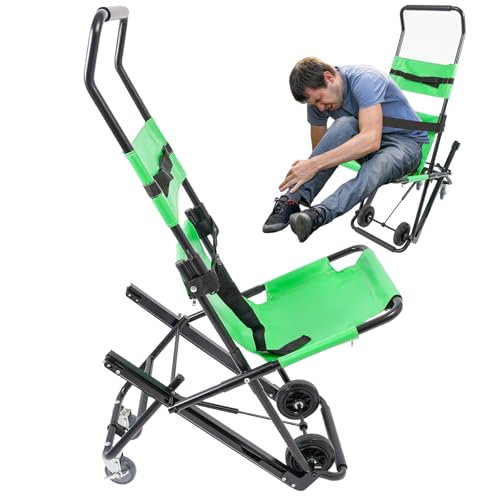
Best for: Escalating environments where space is limited and vehicles require trunk storage. A lightweight aluminum alloy build supports quick deployment.
Why selected: Features four wheels and a track system for smooth stair descent. Adjustable headrest and double safety belts contribute to stability and secure transport.
Limitation: Track design may require careful alignment on very steep stairs or uneven surfaces.
Folding Ambulance Chair, Evacuation Aid (DJCDDM)

Best for: Emergency responders needing a simple, non-electric transfer chair; reliable for stairs and flat areas with straightforward operation.
Why selected: High-strength aluminum and waterproof PVC offer wear resistance and easy cleaning. Headrest and chest straps help accommodate different heights.
Limitation: Weight capacity listed around 350 lb; ensure user weight falls within this range for safe operation.
4-Wheel Stair Chair (Mlonausz)
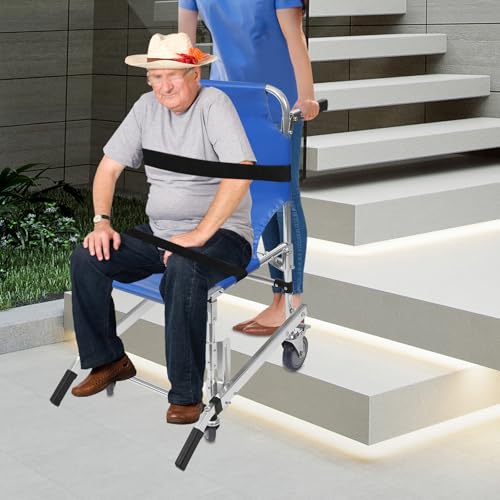
Best for: Seniors and disabled users requiring a stable four-wheel ascent or descent with padded seating. Suitable for home or facility use where frequent stair movement occurs.
Why selected: A padded seat and backrest, high load capacity, and robust aluminum frame support longer service life and comfort.
Limitation: Ensure proper handling to avoid pinching hands during folding or unfolding.
FLYHERO Folding 4-Wheel Evacuation Chair

Best for: Hospitals and emergency teams needing a durable 4-wheel model with versatile handling. Designed for both stair and flat-surface evacuation.
Why selected: 2-in-1 design with retractable handles and four wheels supports flexible handling across terrains. Durable construction resists rust and wear.
Limitation: Ensure proper training on retractable handle use to maximize efficiency and minimize fatigue.
Buying Guide: Key Purchase Considerations
What load capacity do you need?
Choose a chair with a load capacity comfortably above the intended user’s weight. Common ranges are 350–400 lb to accommodate most adults and additional gear during transport.
Which configuration suits your setting?
Two-wheel chairs are compact and quick for tight spaces but may offer less stability on uneven surfaces. Four-wheel designs improve steadiness on stairs and landings but can be bulkier.
Is there a need for track systems or portability?
Track-enabled chairs can glide smoothly on stairs, while folding or wall-mountable models save space in vehicles and clinics. Assess storage options and deployment speed.
Are safety features sufficient?
Look for secure restraints, adjustable headrests, and reliable brakes. Proper restraint systems prevent secondary movement and enhance patient safety during transfers.
What about maintenance and cleaning?
Materials like aluminum, PVC, and rubber resist rust and wear. Waterproof or easy-to-clean surfaces simplify hygiene, especially in medical environments.
Usage scenarios to consider
EMS response, hospital transfer corridors, home care, and fire rescue operations each have unique demands. Align product choices with typical stair configurations and transport distances.
Quick comparison summary
- Best for compact spaces: LINE2design EMS Stair Chair 70015-Y (2-wheel)
- Best for stability in EMS: LINE2design-USA-EMS Mobility Chair 70002-Y (4-wheel)
- Best for vehicle storage: LYNICESHOP Portable Folding Stair Chair
- Best for rugged environments: DYRABREST Folding Emergency Stretcher Chair
- Best all-round support: Mlonausz 4-Wheel Stair Chair
Frequently Asked Questions
- What is an evacuation chair for stairs?
- Do these chairs require electricity?
- Should I prefer a 2-wheel or 4-wheel model?
- What safety features are essential?
- Can these chairs be used for home care?
- How do I maintain an evacuation chair?
An evacuation chair is a portable chair designed to move people safely up or down stairs during emergencies, especially when elevators are unavailable or unsafe.
Most listed models are manually operated and do not rely on electricity, though some designs may include power-assisted features in other variants.
Choose based on space and terrain. 2-wheel chairs are compact and quick for straight stair segments, while 4-wheel chairs offer greater stability on uneven stairs and landings.
Look for secure restraints, adjustable headrests, and reliable braking systems to prevent patient movement during transfer.
Yes, many models are suitable for home use, especially those with foldable designs and manageable weights for caregivers.
Regularly inspect restraints, brakes, and locking mechanisms. Clean surfaces with non-abrasive cleaners and follow manufacturer guidance for storage.