Answering your search for a gait belt with handles, this guide highlights five top options that balance safety, comfort, and ease of use for caregivers. Each choice targets specific needs—whether you’re caring for bariatric patients, the elderly, or someone in physical therapy. The listed products emphasize multiple handles, quick-release buckles, and durable materials to reduce caregiver strain and improve transfer confidence.
| Product | Brand | Why It Stands Out |
|---|---|---|
| Vive Gait Belt (350lbs) Transfer Belt with Handles | Vive | High weight capacity; seven padded handles; quick-release metal buckle; strong for transfers from any angle |
| Gait Belt with 7 Handles (Leetye Mei) | Leetye Mei | Ergonomic seven-handle design; strong polymer buckle; suitable for straight transfers and steps |
| Silimore Gait Belt for Seniors with 7 Handles | Silimore | Adjustable length; seven non-slip handles; quick-release buckle; versatile for home and facility use |
| Posey 6537Q Transfer Belt | Posey | Extra-wide nylon webbing with six grab points; durable and adjustable for a broad range of waist sizes |
| Jacobable Gait Belt with 7 Handles | Jacobable | All-around 7 handles; durable leather and nylon construction; strong grip and safety |
Vive Gait Belt (350lbs) Transfer Belt With Handles

The Vive gait belt is designed for high-capacity transfer support with seven padded handles. Best for caregivers working with heavier patients or those needing multi-angle support during transfers. The metal buckle locks securely, and a quick-release latch allows fast removal when transfers are complete. The belt accommodates waists up to 51 inches, making it suitable for a broad range of body sizes.
Best for: caregivers managing bariatric or heavier patients; settings where multi-angle grips are essential. Limitations: heavier belt may be bulkier for very slim waists; ensure proper sizing to avoid discomfort during long wear.
Gait Belt With 7 Handles For Seniors (Leetye Mei)

This gait belt emphasizes seven handles arranged for ergonomic transfers from any angle, with a 5-inch back support pad for added comfort during longer procedures. The quick-wear release buckle offers simple one-handed operation, making it practical for quick transitions during physical therapy or routine assistive care. The belt is designed to take on a range of tasks from walking assistance to obstacle navigation like stairs.
Best for: nursing staff and home care workers needing flexible grip options; better for shorter, practical transfers. Caution: ensure the polymer buckle remains secure after repeated use to prevent loosening.
Gait Belt For Seniors, 7 Handles (MKEFMEI)
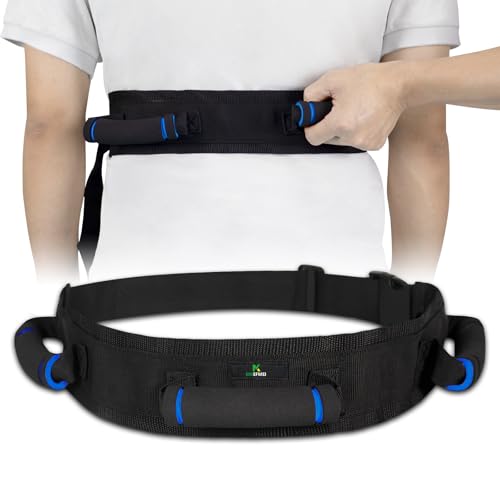
With seven handles and a quick-release buckle, this belt prioritizes safe, directional lifting and repositioning. Made from 80% polyester and 20% nylon, it emphasizes a balance between strength and breathability. The material choice aims to distribute weight evenly to reduce caregiver hand fatigue, making it a practical option for daily home care or clinical settings. A limitation is that some users may prefer additional back support beyond the 5-inch-wide belt.
Best for: caregivers needing a versatile belt for daily transfers at home or in clinics; better for those prioritizing a breathable fabric and quick-release operation.
Gait Belt for Seniors With 7 Handles (Jacobable)

Jacobable’s gait belt features seven evenly spaced handles on a durable leather and nylon construction, designed for all-around support during transfers and ambulation. It can hold up to 300 pounds, making it suitable for many patient transfer scenarios. The multiple grip points aim to provide safer positioning for caregivers in diverse transfer directions.
Best for: caregivers seeking broad grip options and a robust build for varied transfer angles; caution: check for fit and comfort on longer wear to avoid skin irritation if worn for extended periods.
Buying Guide: Key Purchase Considerations
- Weight capacity: Choose a belt that supports the patient’s weight with a comfortable margin. Higher capacity reduces risk during lifts or pivots.
- Number and orientation of handles: More handles offer flexibility for different angles and positions. Seven handles are common and typically cover most transfer scenarios.
- Buckle design: Quick-release buckles enable fast donning and doffing. Ensure the buckle locks securely during use and releases smoothly when needed.
- Material and comfort: Look for breathable fabrics, padded handles, and a wide belt to distribute pressure and minimize caregiver fatigue during extended transfers.
- Adjustability: A broad size range ensures the belt fits a variety of waist measurements, reducing the need for multiple products.
- Cleaning and maintenance: Machine-washable fabrics or easy-clean materials help keep equipment hygienic in homes or facilities.
- Usage context: Consider whether the belt will be used primarily at home, in clinics, or in care facilities, as this influences durability and ease of use requirements.
Frequently Asked Questions
- How many handles should a gait belt have?
– Seven handles are common and provide versatile grip points for most transfers; more handles can offer additional angles but may be unnecessary for simple moves. - Can gait belts be used for stairs or uneven terrain?
– Yes, many models with multiple handles help secure the patient from different positions, though extra caution is advised on stairs. - Are quick-release buckles safe for long-term use?
– When properly engaged, quick-release buckles are secure and convenient; inspect buckles regularly for wear or deformation. - What size is best for a typical adult?
– Look for belts with adjustable waists up to at least 50 inches or more to accommodate a wide range of body sizes. - Are gait belts machine-washable?
– Many are machine-washable; always follow the manufacturer’s cleaning instructions to maintain material integrity. - Which belt is best for caregivers with back strain concerns?
– Belts with multiple, well-distributed handles and padded grips help distribute effort and reduce strain on the back.