Answering the question for caregivers and healthcare buyers: a low air loss alternating pressure mattress can help reduce pressure injuries and improve comfort for bedridden users. These systems distribute weight, reduce moisture buildup, and adjust pressure to suit individual needs. The following selections are among the top options, each best suited for different care environments—from home use to clinical settings. This guide highlights five strong picks, who they’re best for, and practical considerations to help you choose wisely.
Quick comparison table
| Product | Brand | Type | Best For | Notes |
|---|---|---|---|---|
| MedVance Low Air Loss Mattress Replacement System | MedVance | 8″ Deep Cell-On-Cell | Home or facility use with quiet operation | Digital control, CPR deflate |
| Drive Medical Med-Aire Low Air Loss Mattress Replacement | Drive Medical | 20-cell 8″ bladders | Hospitals or facilities needing robust support | Moisture-wicking cover |
| Vive Alternating Air Pressure Mattress Pad | Vive | 130-cell pad | Bedridden individuals needing high surface area coverage | Whisper-quiet pump |
| Vive 8″ Alternating Pressure Mattress | Vive | 8″ mattress with pump | Home care or rental use | Variable pressure settings |
| ProHeal Low Air Loss Alternating Mattress (36”x80”) | ProHeal | 20-cell cell-on-cell | Hospital bed or home care for stages I–III ulcers | Laser-size holes for ventilation |
MedVance Low Air Loss Mattress Replacement System

This 8-inch, cell-on-cell mattress uses an ultra-quiet pump (<20 dB) with a digital control that includes diagnostic alarms. It supports up to 24 hours of power outage protection and features a pillow function at the head. Best for caregivers seeking a compact, quiet system for home or facility use, with quick deflation for emergencies. Note the need for adequate space for the digital panel and ease of use for new caregivers.
- Best for: Home care and light-to-moderate facility use.
- Why chosen: Quiet operation, digital adjustments, emergency CPR deflate feature.
- Limitation: 8″ depth may provide less immersion for very large users compared with taller bladders.
Drive Medical Med-Aire Low Air Loss Mattress Replacement System

Designed for both home and facility environments, this system supports comfort through targeted care and reduces air loss with an 8-inch cell design and a built-in pillow feature for head stability. It includes a moisture-wicking cover to help manage humidity and shear. Ideal for users who require reliable pressure redistribution and a robust, replaceable bladder setup.
- Best for: Patients needing reliable pressure redistribution with moisture management.
- Why chosen: 20 replaceable bladders provide targeted care; vapor-permeable cover reduces moisture buildup.
- Limitation: System weight and setup complexity may require trained staff for optimal use.
Vive Alternating Air Pressure Mattress Pad
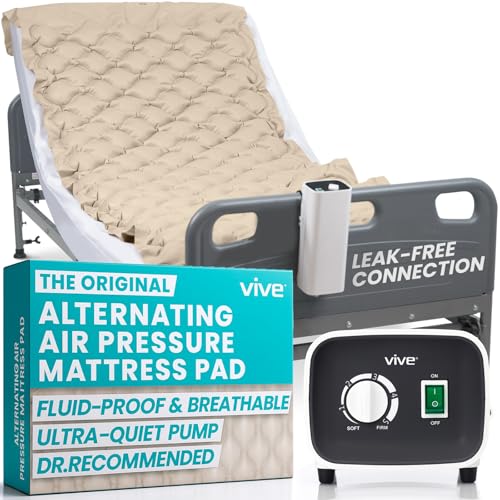
This original bed sore prevention solution features 130 air cells arranged to distribute weight via a proprietary wave-like therapy. A whisper-quiet pump provides multiple pressure levels, and the cycle duration is designed for continuous comfort. Suitable for bedridden users who need extensive surface coverage and customizable therapy.
- Best for: Long-term bedridden users or those needing comprehensive pressure distribution.
- Why chosen: Large 130-cell configuration can reduce pressure hotspots more evenly.
- Limitation: Higher cell count may require more maintenance and regular inspections for leaks.
Vive 8″ Alternating Pressure Mattress

This 8-inch mattress is built for prevention and treatment of pressure injuries with 16 air chambers that are controlled by a variable pump. The head section includes a static air pillow to support the neck, and a static mode is available for general use. Best for home care or rental settings where quiet operation and simple control are priorities.
- Best for: Home care or rental environments needing simple adjustability.
- Why chosen: Variable pressure settings with a dedicated head pillow region.
- Limitation: The static head pillow is fixed; adjustability at the head area is limited compared with full-tilt systems.
ProHeal Low Air Loss Alternating Mattress (36”x80”)

The ProHeal mattress features 20 cell-on-cell bladders designed for stages I–III ulcers, with a 10-minute alternating cycle and a two-layer design to minimize loss during power outages. It emphasizes moisture management through 18 laser-size holes for ventilation and a customizable airflow dial for targeted pressure relief. This is a solid choice for long-term care setups where moisture and skin integrity are priorities.
- Best for: Care environments focusing on skin health and ulcer management.
- Why chosen: Cell-on-cell design reduces bottoming out; adjustable cycles support individualized therapy.
- Limitation: The 36″ width may be restrictive for larger patients or certain bed configurations.
Buying Guide
What should I look for in a low air loss alternating mattress?
Key features include cell design (cell-on-cell versus open-cell), number of bladders, cycle duration, and whether a pillow feature is integrated. Consider the user’s size, mobility, and care setting when choosing between an 8″ depth and deeper options for immersion.
Is a hospital-grade system necessary for home use?
For home use, a compact system with a quiet pump and simple digital controls can meet most needs. Hospital-grade configurations are advantageous in facilities or for users with complex pressure redistribution requirements.
What about moisture management and comfort?
Look for breathable, moisture-wicking covers and suction-free, quiet operation. Laser-size holes and breathable fabrics help manage skin maceration, particularly for immobile users.
How important is the pump noise level?
Lower decibel levels improve sleep quality and patient comfort. Pumps under 25 dB are generally considered whisper-quiet and suitable for bedrooms or shared rooms.
What maintenance should be expected?
Regular inspection for leaks, valve integrity, and cover cleanliness is essential. Replacing bladders or pads as needed preserves therapy effectiveness and prolongs mattress life.
FAQ
- What is low air loss technology designed to do? It redistributes pressure and reduces moisture to prevent skin breakdown.
- Who benefits most from this type of mattress? Bedridden or immobile individuals at risk of pressure ulcers, plus their caregivers.
- Can these systems be used at home? Yes, many models are designed for home use with straightforward controls.
- How long should a typical therapy cycle be? Cycle durations vary; common settings range from 6 to 15 minutes per cycle, depending on the model.
- Do all models have a head pillow feature? Some do; check product specifics for pillow or static head support.
- Are replacements or maintenance parts readily available? Yes, most models use replaceable bladders and standard components through the brand.