Answering the need for reliable water oxygen readings, these meters help maintain healthy aquatic environments. They’re best for hobbyists monitoring home aquariums or koi ponds, hydroponics operators checking nutrient solutions, and researchers measuring water quality in labs or classrooms. The top picks below cover a range of DOC testers, from simple pocket models to multi-parameter kits with long cables and automatic temperature compensation.
| Product | Best For | Main Advantage |
|---|---|---|
| EZTOCH Portable Dissolved Oxygen Meter | Ponds & Aquariums | Comprehensive DO and calibration supplies in one kit |
| GIDIGI Dissolved Oxygen Meter | Deep Water & Outdoor Monitoring | Long cable and Bluetooth data management |
| Rowyet Dissolved Oxygen Meter | General Aquaculture | Clear readings with ATC |
| LOHAND Digital DO Meter LH-D701 | Professional Testing | High resolution with multiple compensations |
| GISNPA DO Meter with Calibration Kit | Lab & Education | Wide range with anaerobic calibration options |
EZTOCH Portable Dissolved Oxygen Meter for Pond and Aquarium

The EZTOCH meter provides two measurement units: mg/L and % saturation, with a test range up to 40.0 mg/L or 300.0% saturation. It includes a 3.6-foot probe cable, a zero-oxygen calibration solution, electrolyte solutions, and membranes. This makes it convenient for ponds, aquariums, koi ponds, and hydroponic setups where oxygen levels below 6 mg/L can stress aerobic life. Best for hobbyists needing a ready-to-use kit without extra purchases, and for those who want to monitor both DO and relative saturation in one device. A potential limitation is that frequent calibration requires keeping additional solutions on hand, which may be a consideration for casual users.
Who it’s best for: Home aquarium keepers, koi pond owners, and small-scale hydroponics operators who want an all-in-one DO meter with straightforward operation.
GIDIGI Dissolved Oxygen Meter with ATC and Salt Compensation
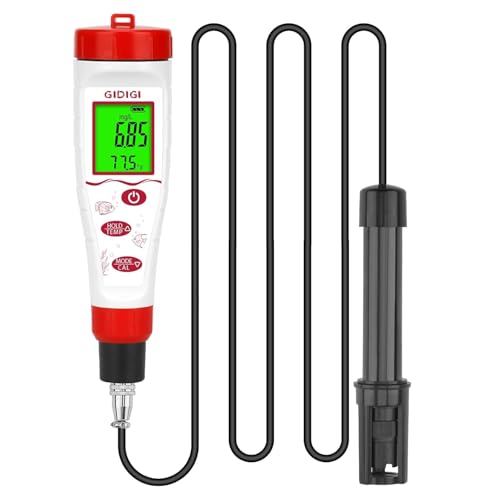
This kit offers mg/L and % modes, automatic temperature compensation, and manual salinity and altitude adjustments. It can connect to a phone app via Bluetooth for data storage and sharing, which is useful for marine hobbyists and professionals tracking changes over time. The extended 9.84-foot cable allows testing in deeper water, reducing the need to move sensors. A limitation is reliance on app connectivity for advanced features; users who prefer a simple handheld readout may find it less essential.
Who it’s best for: Marine enthusiasts, large aquariums, and outdoor ponds where long cable reach and data logging are helpful.
Rowyet Dissolved Oxygen Meter with ATC

Rowyet emphasizes accuracy and quick results with ATC to stabilize readings across temperature changes. It covers DO from 0.0–40 mg/L and 0.0–300.0% saturation, plus a broad 0.1–40.0°C temperature range. This makes it suitable for aquaculture, ponds, and home aquariums where rapid, repeatable readings matter. A caution is that users should ensure the electrode is properly filled and maintained for consistent results.
Who it’s best for: General aquaculture and hobbyists who want clear, fast readings with automatic temperature compensation.
LOHAND Digital Dissolved Oxygen Meter with ATC

LOHAND’s LH-D701 provides a 0.00–20.00 mg/L DO range with high resolution (0.01 mg/L) and accuracy up to ±0.3 mg/L. It also measures DO saturation, temperature, and offers clear, backlit display and multiple compensation options (ATC, salinity, atmospheric pressure). The device is designed for professional-level testing in aquaculture, wastewater, and hydroponics. A limitation is that it may be more feature-rich than a casual user needs, impacting price and simplicity for small hobby setups.
Who it’s best for: Professionals and dedicated hobbyists who require high precision, multiple compensation features, and robust data display.
GIDIGI 6-in-1 Smart DO Meter
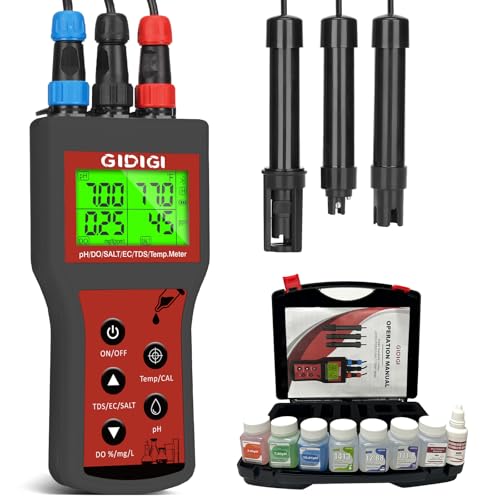
This multi-parameter device displays DO, pH, salinity, TDS, EC, and temperature on one screen. It includes Bluetooth for data logging, calibration solutions, membranes, and a rugged case. Its compensation features cover salinity and altitude, making it versatile for ponds, aquariums, and hydroponics. The trade-off is that its feature set may be more complex to operate for beginners who only need DO readings.
Who it’s best for: Users who want a single, portable tool for multiple water quality parameters and easy data management via the app.
Monitor Dissolved Oxygen Test Kit (60 Tests)

Generic monitor kits provide 60 tests to measure DO in freshwater, marine, ponds, and water supplies with a range of 0–15 ppm and 0.5 ppm resolution. They’re simple to use and suitable for classrooms, small-scale labs, and hobbyists who want a basic kit for frequent checks without a high upfront cost. A limitation is the broader single-purpose use; it does not include an integrated meter or ATC features found in other models.
Buying Guide: Key Purchase Considerations
- Measurement range and resolution: If you monitor shallow aquariums, a 0–40 mg/L range with 0.01 mg/L resolution is ideal. For deeper or more variable water, look for longer cables and higher saturation ranges (0–300%).
- Calibration and compensation: Automatic temperature compensation (ATC) improves accuracy. Salinity and altitude compensation matter in ponds and hydroponic systems with varying salinity or elevation.
- Connectivity: Bluetooth or app data logging is helpful for trend tracking but adds complexity. Basic handheld meters are simpler and more intuitive for beginners.
- Probe cable length: Longer cables enable testing at depth or from the shore. Short cables are compact but limit reach in larger tanks or ponds.
- Multi-parameter capability: If you need more than DO (pH, EC, TDS, temperature), multi-parameter meters save space and simplify testing workflows.
- Calibration supplies: Some kits include calibration fluids and membranes; others require separately purchased items. Check what’s included to avoid extra costs.
Frequently Asked Questions
- What is a good dissolved oxygen level for ponds?
Most pond systems aim for at least 6 mg/L of dissolved oxygen to support aerobic organisms; higher levels provide a buffer for fluctuations. - Do I need ATC or salinity compensation?
ATC improves reading stability with temperature changes. Salinity compensation is useful in marine or brackish setups and hydroponics with nutrient solutions. - Are handheld DO meters better than test kits?
Handheld meters provide real-time readings and quick trends, while test kits are cost-effective for periodic checks. Some users prefer a combination depending on their monitoring schedule. - Can I use these meters for hydroponics?
Yes. Many meters support DO measurements in nutrient solutions, often with recommended DO ranges for plant roots (commonly 5–10 mg/L). - What maintenance is required for DO meters?
Regular calibration, electrode cleaning, and membrane replacement are typical maintenance steps. Follow the manufacturer’s instructions for best results.