Direct answer: These patient lift assist devices are designed to help caregivers and patients with transfers, standing aids, and fall prevention. They are best for adults who can bear some weight and for caregivers seeking safer, less strenuous transfers at home or in small facilities. The top picks below emphasize stability, ease of use, and clear safety features, with practical notes on room size and operation.
Buying at-a-glance: the following five products are selected for relevance to “patient lift assist devices,” focusing on sit-to-stand lifts, stand-assist devices, and portable or chair lifts. The table summarizes core aspects to compare quickly.
| Product | Best For | Weight Capacity | |
|---|---|---|---|
| VOCIC Sit to Stand Lift (AY03) | Home care with moderate mobility | 400 lbs | Heavy-duty steel frame; soft grips; no safety belt |
| Vive Mobility Sit to Stand | Caregivers needing easy, low-effort transfers | Not specified in features | Wide base, soft grip, cushioned seat |
| MAIDeSITe Electric Chair Lift (JC35M3) | Seniors needing independent standing assistance | 300 lbs | Motorized lift with emergency stop and cordless operation |
| Parabound Transfer Sling | Transfers with slings for comfort | Not specified | Durable padding, ergonomic handles |
| Leetye Mei Transfer Sling | Home and hospital care transfers | Not specified | Multiple handles; soft nylon mesh |
VOCIC Sit to Stand Lift AY03 Upgraded

The VOCIC AY03 Sit to Stand Lift features an active open-design that does not include a safety belt restraint. It is intended for individuals who can sit up and support their own core. Best for caregivers seeking a sturdy, belt-free transfer aid for patients who can bear some weight. The unit has a heavy-duty 400 lbs capacity with a reinforced steel frame for stability during lifts. Soft foam-wrapped handgrips reduce hand fatigue, and padded shin guards with a split-seat cushion improve comfort during transfers.
Best for: users who can assist with their own core control and caregivers who prefer belt-free operation. Limitations: not suitable for completely immobile or paralyzed patients. Consider space requirements due to frame width.
Vive Mobility Sit to Stand

The Vive Mobility Sit to Stand Stand-Assist is designed to help transfer patients who can stand enough to support roughly 60-70% of their body weight. It assists in moving from bed to wheelchair, toilet, or sofa, reducing fall risk and caregiver injuries. The base is wide enough to provide stability, but buyers should measure doorway widths as the base can be up to 26 inches wide. The handrails are foam-covered for a secure, comfortable grip, and cushions on the shin rests and seat pads add comfort.
Best for: in-home users and facilities where a straightforward assistive transfer is needed. Better for: users who require a little extra lift assistance without a full motorized lift. Caution: may not fit through narrow doorways.
MAIDeSITe Electric Chair Lift JC35M3

The MAIDeSITe JC35M3 electric chair lift supports independent standing assistance up to 300 lbs and is designed to minimize caregiver strain. It features a motorized lift with a cordless handheld remote and a large, easy-to-use control. An emergency stop button and non-slip pad provide safety during use. The cordless operation makes it convenient for home use.
Best for: seniors who want more independent standing assistance and caregivers seeking a motorized option. Choose this if you value cordless operation and a straightforward lift sequence. Limitation: battery life and charging times should be considered for frequent use.
Parabound Transfer Sling For Elderly

The Parabound Transfer Sling is designed to enhance seamless mobility for elderly and disabled users. Made with durable Oxford Cloth and padded with soft materials, the sling remains tear-resistant while offering comfortable support. The double grip design provides ergonomic handles, with a textured surface and reinforced stitching for stable transfers between bed, chair, and wheelchair.
Best for: users who need a soft, padded sling with secure grip during transfers. Choose this when comfort and durability are priorities. Caution: not a stand-alone lift—use in combination with a compatible lift device as needed.
Leetye Mei Transfer Sling
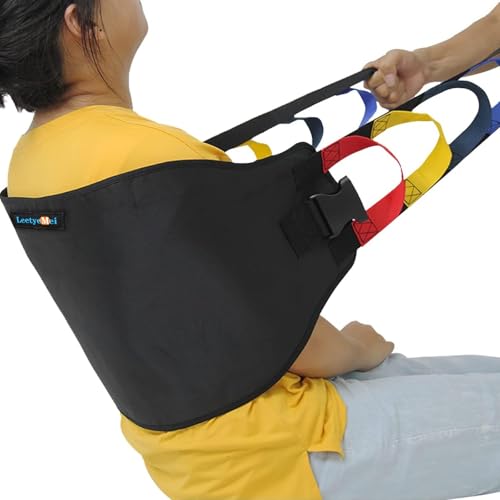
The Leetye Mei Transfer Sling is designed for safe bed-to-chair and wheelchair transfers. It features five handles at each end and a breathable nylon mesh fabric that balances comfort and support. The textured nylon surface and reinforced stitching help caregivers achieve stable lifts, making it a practical companion tool for home and hospital care.
Best for: caregivers who want multiple grip options and a comfortable strap for frequent transfers. Avoid this if a standing-only device is required without a sling component.
Buying Guide
What to consider when choosing a patient lift assist device
- Transfer needs: Is the user mostly standing with support, or needing full assists from bed to chair?
- Weight capacity: Confirm that the device supports the user’s weight and any added gear or sling.
- Mobility and space: Consider doorways, hallways, and room size to ensure base width and maneuverability fit your environment.
- Ease of use: Look for soft-grip handles, clear control interfaces, and whether cordless operation is beneficial.
- Safety features: Check for emergency stops, non-slip surfaces, and whether a belt is included or not.
- Maintenance and durability: Steel frames, padded components, and easy cleaning contribute to long-term reliability.
- Portability vs. permanence: Decide between portable/slim designs and heavier, more robust units for home use.
How to compare products effectively
- Compare base width and footprint to ensure doorways and rooms accommodate the device.
- Evaluate whether the product is belt-free or uses slings or belts, based on patient needs and clinician preferences.
- Assess whether cordless operation or manual operation better suits your daily routine.
- Check if the product includes a comprehensive sling or requires separate purchase of a compatible sling.
- Look for padded seating and shin guards for added comfort during longer transfers.
Practical tips for safe use
- Always ensure the patient can participate to some degree if using sit-to-stand devices.
- Measure doorways and hallway widths before purchase to confirm compatibility.
- Inspect for fluid, loose parts, or wear on the sling and contacting surfaces before each use.
- Use the emergency stop and manual override options if power loss occurs.
Frequently asked questions
- What is the main difference between a sit-to-stand lift and a chair lift?
Answer: Sit-to-stand lifts assist patients who can partially bear weight to transition to a standing position, while chair lifts help transfer a person from floor to chair or from floor with a mechanical assist. - Can these devices be used in small apartments?
Answer: Yes, but check base width and maneuverability; slings and portable lifts may fit better in tight spaces. - Do they require professional installation or training?
Answer: Most models are designed for home use with straightforward assembly and user guides; some items may benefit from caregiver training. - Are cordless lifts battery-powered?
Answer: Some models feature cordless operation with rechargeable handsets for convenience; verify the battery life and charging time. - Is a sling included with every lift?
Answer: Slings are often included with some models (or sold separately); verify what is included in the package before purchasing. - What safety features should I prioritize?
Answer: Look for solid base stability, slip-resistant surfaces, emergency stop, and secure grip options on handles.