If you’re researching platform lifts to aid mobility at home, these options are designed to help with standing, transfers, and independence. They suit buyers seeking safer ways to rise from chairs, transfer between seats and heights, or assist in daily activities without heavy lifting. The top picks below are best for caregivers seeking straightforward setup, solid safety features, and reliable performance in a domestic setting. The table summarizes each recommended product’s core use and suitability for different needs.
| Product | Best For | Key Benefit |
|---|---|---|
| Little Boost Platform | Chair users with knee/back issues | 3-inch lift under chairs; no assembly |
| PPOLB Electric Chair Lift | Bathtub and floor transfers | Remote-operated, suction cups for anti-slip |
| ProTraverse Stand Assist Lift | Medical transfers and sit-to-stand | Five-height options; padded supports |
| Goplus Foldable Walker With Platform | Mobility-assisted walking | Removable arm supports; sturdy, foldable |
| HLOMAUD Electric Hydraulic Wheelchair Lift | Vehicle-based mobility | Heavy-duty steel frame; hydraulic lift |
Little Boost Platform 3 Inch Recliner Riser

The Little Boost Platform is a 3-inch riser designed for recliner chairs. Best for users with knee, back, or joint limitations who want a stable lift under a chair base up to 27 inches by 27 inches. It requires no assembly and features a security lip and rubber corner pads to minimize chair movement on various floor types. This product is suited for people who want a simple, low-profile elevation to aid standing and sitting with minimal setup. A notable limitation is its fixed height; users needing multiple elevation options may look elsewhere.
PPOLB Electric Chair Lift – Floor Lift

PPOLB’s Electric Chair Lift is designed for safety during falls recovery and daily bathing, offering up to 308 lbs capacity and six heavy-duty suction cups for secure anchoring on tile, marble, or hardwood. It operates via a remote and charges in about 2.5 hours, delivering over 50 lift cycles per charge. It is best for nearby caregivers and seniors who need independent, hands-free operation in tight spaces like bathrooms or small rooms. A potential limitation is reliance on a smooth floor surface for maximum grip and stability.
ProTraverse Stand Assist Lift
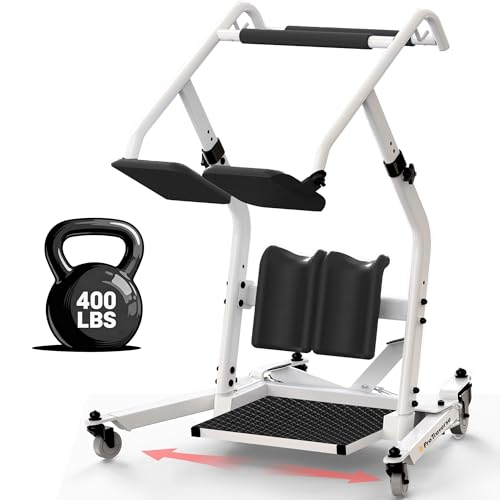
The ProTraverse Stand Assist Lift focuses on safe sit-to-stand transfers and surface-to-surface moves. It features dual padded leg supports, non-slip footrests, cushioned handrails, and a five-height adjustment range with two leg pad options. It is best for users who require reliable, ergonomic support during frequent transfers. A limitation to consider is its larger footprint, which may require more space in homes or clinical settings.
Goplus Walkers for Seniors With Platform

This foldable walker features a platform option with removable padded armrests and a sturdy aluminum frame. Its design emphasizes ease of transport, one-hand folding, and a stable five-point base. Best for individuals needing a lightweight mobility aid that can convert into a walking frame with some elevation support. A caution is that the platform weight and fold mechanism can add complexity for users who require minimal assembly and setup.
HLOMAUD Electric Hydraulic Wheelchair Platform Lift

The HLOMAUD wheelchair platform lift is designed for vehicle-based mobility. It uses an electric hydraulic system and a heavy-duty steel frame to support disabled and elderly users during transfers in vans, cars, or trucks. This option is best for those who need a portable, in-vehicle lift with strong construction. A potential limitation is installation complexity and the need for vehicle compatibility checks before purchase.
Buying Guide
What should you consider when choosing a platform lift? Start with intended use: chair risers are ideal for independent seating and rising, while floor lifts and stand-assist devices better support transfers and caregiver-assisted activities. Check weight capacity, base footprint, and floor-surface compatibility to ensure safety on tiles, hardwood, or vinyl. Look for non-slip features, secure locking systems, and ease of operation—remote controls or simple handles can reduce strain for both users and caregivers. If you need in-vehicle capability, prioritize hydraulic lifts designed for cars or vans and verify vehicle fit. Consider portability, storage, and whether you prefer a fixed-height solution or adjustable-height devices for growing needs.
Frequently Asked Questions
- Who should consider a chair lift platform? People with knee or back pain who need a stable boost to stand or sit without lifting-heavy assistance.
- Are floor lifts safe for bathrooms? Yes, many models use suction cups and non-slip designs; ensure a dry surface and proper installation.
- What capacity is typical for these products? Capacities range from about 308 lbs to 450 lbs depending on the model and use case.
- Can platform lifts be used with vehicles? Some hydraulic lifts are designed for vehicles; check compatibility and installation requirements with the supplier.
- Do these devices require professional installation? Some require minimal setup, while others (especially vehicle lifts) may need professional installation.
- How do I choose between a sit-to-stand aid and a floor lift? Sit-to-stand aids help transitions in one location; floor lifts excel at independent transfers or bath/shower routines.