Answering your search for a reliable portable blood pressure monitor: these devices offer easy at-a-glance readings, compact design, and memory for multiple users, making them ideal for home use, travel, or aging family members. The top picks here suit different needs, from voice-assisted tracking to app integration, and are best for users seeking quick, accurate readings without clinical equipment.
Summary table of selected products
| Product | ||||
|---|---|---|---|---|
| Oklar Wrist Blood Pressure Monitor | Wrist cuff | Voice-assisted readings for visually impaired users | 240 readings (2 users) | None |
| iHealth Track Upper Arm Monitor | Upper arm cuff | Smartphone syncing and tracking | Up to 99 readings on device | Bluetooth |
| Omron Evolv | Upper arm, single-piece design | Clinically validated, easy setup | Up to 100 readings | Bluetooth |
| iHealth Neo | Upper arm cuff | Ultra-thin, portable, app-enabled | Stored data on device unclear | Bluetooth |
| BENECEN Blood Pressure Monitor | Wrist cuff | Budget-friendly, simple readings | 199 readings | None |
Oklar Wrist Blood Pressure Monitor

Best for users who value voice guidance and dual-user memory. This device stores up to 240 readings across two users, helping compare trends over time. It delivers fast measurements in about 35 seconds and shuts off after 60 seconds of inactivity to conserve battery life. The voice broadcast feature aids those with reduced vision, with volume control and an option to mute using SET and MEM buttons. Cuff size ranges from 4.92 to 8.46 inches, suitable for many adults.
Best use scenarios: home monitoring for two people, seniors who prefer audible feedback, quick daily checks. Caution: wrist-style monitors can be sensitive to positioning; ensure the cuff sits properly at heart level for accurate results.
iHealth Track Smart Upper Arm Blood Pressure Monitor
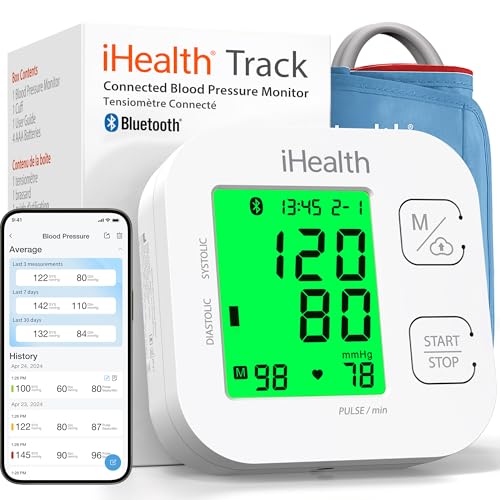
Best for users who want app-based tracking and cross-device data management. It features a wide range cuff for standard to large arms, Bluetooth compatibility, and an easy two-button operation. The display uses a coded color system (GREEN/YELLOW/RED) to indicate whether readings are optimal. It supports up to 99 readings on the device and unlimited smartphone recordings via the iHealth app, requiring Bluetooth 4.0 or later. No calibration required.
Best use scenarios: daily health tracking with mobile syncing, households needing shared data access. Limitation: smartphone app reliance may affect users without compatible devices.
OMRON Evolv Wireless Blood Pressure Monitor

Best for proven clinical reliability in a compact, one-piece design. The Evolv stores up to 100 readings and includes Irregular Heart Beat Detection to flag potential concerns for physician review. It emphasizes simple operation and portability, suitable for frequent travelers or minimalists who want dependable readings with minimal setup. Consider this if you value a trusted brand and a straightforward setup. Caution: irregular heartbeat detection is not a diagnosis; consult a clinician for medical interpretation.
iHealth Neo Wireless Blood Pressure Monitor

Best for portability with app-enabled convenience. The Neo emphasizes ultra-thin, lightweight design for easy portability and app connectivity for iOS and Android. It supports fast, gentle measurements with a large display, and one-button operation. The device aims at users who travel frequently and want quick readings on the go. Limitation: while app-based syncing is convenient, some users may prefer independent memory storage without relying on a phone for access to data.
BENECEN Blood Pressure Monitor

Best for a budget-conscious option with robust memory. This wrist cuff monitor offers 199 memory entries with date and time stamps, making it practical for daily tracking over weeks. It uses a one-button start and shows results on a large digital display. It runs on two AAA batteries, with auto-shutoff after inactivity to preserve power. Choose this if you want a simple, cost-effective device for regular use, but verify cuff fit if you have a larger or smaller wrist.
Buying Guide
What type of blood pressure monitor should I choose?
Upper arm monitors are generally more accurate and recommended by clinicians. Wrist monitors are more portable but require correct positioning at heart level. Choose based on where you will measure most often and how critical accuracy is for your needs.
How important is memory and data management?
Memory helps track trends over time. Devices with multiple-user memory suit households. Bluetooth or app syncing is valuable for long-term records but depends on your comfort with using smartphones and apps.
What features are most useful?
- Irregular heartbeat detection adds monitoring depth but is not a diagnosis.
- Voice guidance aids visually impaired users.
- Backlit displays improve readability in low lighting.
- Battery type and life influence portability and readiness for travel.
What are potential limitations to watch for?
- Position sensitivity for wrist monitors may affect accuracy.
- App-based data requires compatible devices and stable connectivity.
- Some models have limited on-device memory; consider whether you need long-term storage without a phone.
How do I interpret readings?
Readings typically include systolic/diastolic pressure and often heart rate. Use the device’s color-coded indicators or the accompanying app to understand whether readings are within a healthy range for your age and health status. Always consult a clinician for readings that are consistently outside normal ranges.
Choosing the right monitor for a buyer’s profile
- First-time users or seniors: look for one-button operation, large displays, and audible feedback.
- Travelers: prioritize ultra-portable designs and long battery life.
- Tech-friendly users: prioritize Bluetooth/app connectivity and robust data export options.
Key comparison considerations
- cuff type (upper arm vs wrist)
- memory capacity and number of users
- data connectivity (Bluetooth, app integration)
- display readability (backlighting, font size)
FAQ
Q: Do I need a clinically validated monitor? A: Clinically validated devices tend to provide reliable measurements and are preferred for medical monitoring.
Q: How often should I measure blood pressure? A: Follow your clinician’s guidance; many users measure daily or several times per week to track trends.
Q: Can I rely on a wrist monitor for accuracy? A: Wrist monitors can be accurate when positioned correctly at heart level; upper arm monitors are generally more consistent.
Q: Is smartphone connectivity necessary? A: Not necessary for all users; it adds data tracking convenience but may be optional on some models.