Answering the most common buyer question: which sit-to-stand devices best support transfers for elderly or disabled users? This guide highlights five reliable options, detailing who each is best for, why it was selected, and practical limits to consider. These devices aid transfers from bed or chair to wheelchair or toilet, helping caregivers reduce strain while promoting independence. The top picks emphasize stability, ease of use, and adaptability across spaces. Use the summary table below to compare core features at a glance.
| Product | Best For | Key Feature |
|---|---|---|
| VOCIC AY03 | Active, partially mobile users | High weight capacity; soft grip and padded supports |
| PERLECARE | Users needing adjustable height and added safety strap | Customizable height with belt and easy setup |
| VOCIC AY13 | Narrow spaces and carpeted floors | All-terrain wheels; widened base |
| Vive Mobility | Home and facility use with doorways | Soft grips; caution about doorway width |
| Bezioie | Budget-conscious transfers | Solid steel frame; four casters |
VOCIC AY03 Sit To Stand Lift

Best for users who can sit up and support their own core strength, the VOCIC AY03 is a sturdy transfer aid with a high 400 lb weight limit. The design features an active open-frame that omits a safety belt restraint, prioritizing dignity and user control during transfers. It is ideal for caregivers who work with partially mobile patients who require a stable seat and controlled ascent. A notable limitation: not suitable for completely immobile or paralyzed individuals.
Why it was chosen: The reinforced high-grade steel frame and thickened construction deliver dependable stability for everyday use in clinics or at home. Soft foam-wrapped handgrips reduce hand fatigue, while integrated shin pads and fully padded split-seat cushions enhance comfort throughout transfers. This combination supports safer stand-to-sit cycles and back-to-back transfers with minimal effort.
Best for: Care teams or family caregivers managing patients who can engage their core and tolerate a stand-assisted transfer. Choose this if you need robust support without a belt restraint.
Caution: The absence of a safety belt means this device relies on user engagement and upper body strength. Avoid using with completely immobile patients.
PERLECARE Sit To Stand Lift
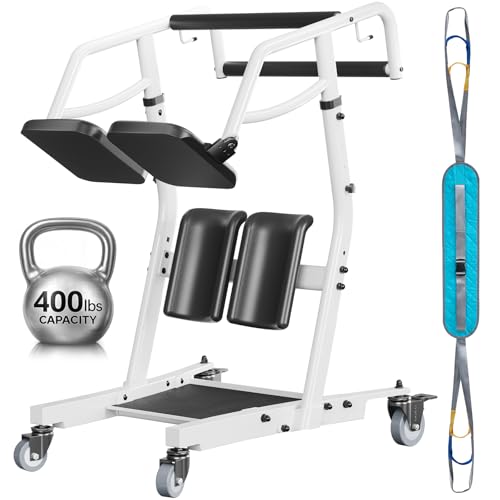
The PERLECARE model stands out for customizable height options and an added safety strap. It’s designed to accommodate users of varying heights with adjustable seat and knee pad heights, supporting proper hip and knee alignment. The safety strap provides extra stability during partial-sit transfers or when the patient isn’t fully seated. It also highlights an upgraded frame and base for stability and a 26.5-inch width to fit through many doorways.
Why it was chosen: The height-adjustment system enables ergonomically tailored transfers, reducing back and knee strain for caregivers. The extra safety strap helps prevent falls during critical moments of the transfer. The stand assist’s base and frame are engineered to minimize tilting, which is essential for safer home or facility use.
Best for: Users who need precise height customization and additional fall prevention. Choose this if you value an explicit safety belt option and a compact doorway fit.
Caution: The device requires setup time to adjust heights for a perfect transfer. Ensure doorway clearance before use to navigate through rooms smoothly.
VOCIC AY13 Sit To Stand Lift

Designed for better navigation in narrow spaces, the AY13 offers upgraded all-terrain wheels and a widened base. This model supports easy transfers from beds, chairs, or toilets with a focus on reducing caregiver effort. It is especially suitable for users who require smoother mobility across carpet and hard floors while maintaining a low profile for under-bed access.
Why it was chosen: The all-terrain wheels help maneuverability on diverse indoor surfaces, and the widened base improves balance during transfers. The design supports quick, stable positioning near toilets or beds, making daily routines more efficient.
Best for: Homes with mixed flooring and tight hallways. Choose this if you need confident maneuverability and a low-profile base for bed access.
Caution: All-terrain wheels may require occasional maintenance to maintain quiet operation and stillness on uneven surfaces.
Vive Mobility Sit To Stand Lift

The Vive Mobility lift focuses on ease of use and clear safety cues. It supports transfers for individuals who can bear a portion of their weight and helps reduce fall risk for both patient and caregiver. The design emphasizes soft-grip handrails and cushioned seat components for comfort during stand-to-sit cycles. However, the base width of 26 inches may not fit narrow doorways, so measure doorway dimensions before purchase.
Why it was chosen: This model blends straightforward operation with comfort-focused details like cushioned supports. It is well-suited for home settings and can be used in facilities where caregivers need dependable assistance without complex setup.
Best for: Home care or facilities with standard doorways and a focus on caregiver ergonomics. Choose this if you value a familiar transfer process with a gentle grip.
Caution: Verify doorway width prior to purchase to avoid space-related transfer barriers.
WHROLLIS Sit To Stand Lift

WHROLLIS emphasizes safe, effortless transfers for users who can bear 60-70% of their weight. The heavy-duty steel frame is engineered to minimize lateral sway, providing sturdy support during transfers. Soft foam-wrapped handrails, padded shin rests, and a split-seat cushion are designed to improve comfort and distribution of pressure during sit-to-stand and stand-to-sit cycles.
Why it was chosen: It matches a balance of durability and user comfort, with a focus on long-term reliability for home or facility use. The four-caster base enhances maneuverability across rooms, aiding caregivers in mid-transfer positioning.
Best for: Caregivers needing a dependable, sturdy lift that prioritizes stability and comfort. Choose this if you want a robust frame with thoughtful padding for extended usage.
Caution: Check for adequate clearance and ensure the base can be navigated through doorways and around furniture.
Buying Guide
What should you consider when selecting a sit-to-stand lift?
- Weight capacity: Choose a model that comfortably supports the patient’s weight plus a safety margin.
- Height and seat adjustments: Look for adjustable seat height and knee pad positions to fit the user’s body proportions.
- Safety features: Consider safety belts or optional straps, anti-tilt bases, and stable bases for transfers.
- Mobility and space: Assess doorway width, room layout, and whether all-terrain wheels are needed for carpet or uneven surfaces.
- Ease of use: Favor models with intuitive handles, cushioned grips, and straightforward assembly or breakdown for quick transfers.
- Care setting compatibility: Determine whether the device is better suited for home care, assisted living, or clinical settings.
Frequently Asked Questions
- Who should use a sit-to-stand lift? – Individuals who can bear partial weight and who need assistance transitioning between seated and standing positions.
- Do these devices require belts or restraints? – Some models include safety belts; others rely on user strength and grip. Always follow manufacturer guidance.
- Can sit-to-stand lifts fit through standard doorways? – Many models, especially those with wider bases, may require measuring doorways before purchase.
- What maintenance do these lifts need? – Regular inspection of wheels, frames, and padding helps ensure safe operation. Follow the user manual for cleaning and checks.
- Are sit-to-stand lifts suitable for home use only? – They are commonly used at home and in facilities; choose a model that fits your space and daily routine.
- Is a weight capacity of 400 lbs common? – Yes, several models offer robust capacity, suitable for a wide range of users and caregiver needs.