Answer: Sit-to-stand patient lifts help caregivers and mobility-impaired individuals transfer from sitting to standing with controlled support. The top picks below are best for light to moderate mobility, home use, and assisted living environments. They emphasize stability, ease of use, and comfort for users who can partially bear weight. This guide highlights five options, explains who they suit, and compares features to help you choose wisely.
| Product | Best For | Key Benefit |
|---|---|---|
| Active, semi-mobile users | High weight capacity and padded comfort | |
| Home care, caregivers | Simple transfers with reduced fall risk | |
| Post-surgery or transitional rehab | Adjustable height and extra safety strap | |
| Narrow spaces, carpeted areas | All-terrain wheels and widened base | |
| Independent seniors seeking dignity | Comfort-focused with padded supports |
VOCIC AY03 Sit to Stand Lift

The VOCIC AY03 is designed for individuals who can sit up and support their own upper body. It features an active open-design and does not include a safety belt restraint. It provides a heavy-duty 400 lbs capacity with reinforced steel for stability. The cushioned handgrips, shin pads, and split-seat cushions aim to reduce fatigue during transfers. This model is best for users who can participate in the transfer and for professional or home caregivers seeking a durable, supportive lift.
Best for: Semi-mobile users who can participate in transfers with core support. Avoid if the patient is completely immobile or paralyzed.
Limitation: It does not include a safety belt, which may be needed for higher-risk transfers.
Vive Mobility Sit to Stand

The Vive Mobility Sit to Stand helps transfer patients who can bear about 60-70% of their weight. It’s designed for both home use and facilities, aiming to reduce falls and caregiver injuries. A note to consider is doorway width: the base can be 26 inches wide, which may not fit through narrow spaces. The soft foam-grip handrails and cushioned seat support steadiness during transfers.
Best for: Those who need gentle lift assistance at home or in facilities, with attention to doorway constraints.
Limitation: May not fit very narrow doorways due to its base width.
PERLECARE Sit to Stand Lift
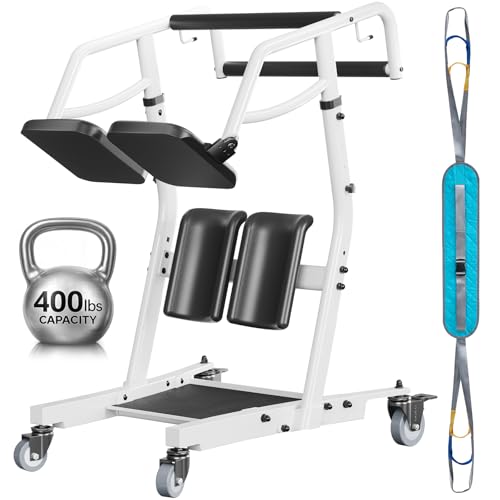
The PERLECARE sit-to-stand lift offers adjustable height options for the seat and knee pads, with two knee pad height options and three seat height options. An additional safety strap enhances fall prevention, and the upgraded frame improves stability. The base width is 26.5 inches, allowing passage through many doorways, and quick-install seating simplifies setup. This model emphasizes customization for comfort and safety during transfers.
Best for: Users needing a customizable fit and improved stability during sit-to-stand transfers, especially after surgery or for those with variable height needs.
Limitation: Requires attention to doorway width in tight spaces, as with other stand assists.
VOCIC AY13 Sit to Stand Assist

The VOCIC AY13 is engineered for users who retain some lower body strength and need an ergonomic transfer aid. It features upgraded all-terrain wheels for carpeted or uneven surfaces and a widened base to simplify toilet access and bed transfers. The design targets easy maneuverability in narrow hallways and through thresholds. This option is best for active transfers in varied home layouts.
Best for: Individuals who require smoother movement across different indoor surfaces and wider base stability for toileting and wide-space transfers.
Limitation: While adaptable, it may be less suitable for users who cannot bear any weight at all.
Lumex LF1600 Stand Assist

The Lumex LF1600 Stand Assist aims to restore independence for adults and elderly seniors. It emphasizes safe, easy transfers with a focus on caregiver-friendly design. Cushioned knee pads, ergonomic handbars, and a padded seat support comfortable seated or standing transitions. This model suits individuals seeking dignity and stability in daily life transfers.
Best for: Users prioritizing comfort and caregiver ease during repeated sit-to-stand transfers.
Limitation: As with many models, doorways and space can affect mobility in tight rooms.
Buying Guide: How To Choose A Sit-To-Stand Lift
What weight capacity do you need? Most sit-to-stand lifts support 180 kg (about 400 lbs) or more. Choose a model with a weight limit above the user’s weight plus a safety margin.
How adjustable should it be? Look for height-adjustable seats and knee pads to fit different heights and ensure proper hip-knee alignment during transfers.
Is the base width important? A wider base increases stability but may not fit through narrow doorways. Measure doorway widths and compare with base dimensions.
Is comfort a priority? Cushioned seats, foam-handrails, and padded leg supports reduce caregiver fatigue and user discomfort during transfers.
Do you need portability? Some models have wheels and compact frames for maneuverability in small spaces or multi-room homes.
What safety features are included? Consider extra safety straps, stable base construction, and a design that minimizes slippage or tipping during transfers.
FAQ
- What is a sit-to-stand lift best used for? It assists users who can bear partial weight to transfer from sitting to standing with caregiver support.
- Do all models require a safety belt? Not all do; some designs exclude belts to prioritize user participation, while others offer optional safety straps.
- Can these lifts fit through standard doorways? Many models have base widths around 26 inches, but always measure your spaces first.
- Are these lifts suitable for carpeted floors? Several models feature all-terrain wheels that work on carpet and thresholds.
- Is assembly required? Most models have quick-install seats, but always check the product manual for setup steps.
- Who should use a stand assist lift? Best for caregivers in homes or facilities supporting semi-mobile users or those recovering from surgery.