Answering the buyer’s search, these at‑home insemination kits and syringes are designed for couples seeking privacy, convenience, and controlled sperm delivery. This guide highlights five practical options, focusing on kits that emphasize comfort, leak‑proof collection, and clinician‑informed design. Best for couples exploring private conception, first‑time DIY insemination, or those seeking alternatives to clinical settings. The right choice depends on comfort with handling, reach, and waste minimization. Below is a quick comparison to help you pick the right kit for your needs.
| Product | Best For |
|---|---|
| Frida Fertility At-Home Insemination Kit | Best for minimal sperm waste and ease of use |
| Surmu At Home Insemination Kit (6 Pack) | Best value with extended reach |
| Dompook At-Home Insemination Kit | Best all‑round for beginners |
| Airivio At Home Insemination Kit | Best sterile materials and leak protection |
| Mosie Baby Insemination Kit | Best FDA‑cleared option |
Frida Fertility At-Home Insemination Kit

Best for minimal sperm waste and precise control. The kit includes an easy‑grip insemination syringe with a comfort handle, a gentle rounded tip, and an extended barrel for optimal placement. It also features spill‑free collection cups with a slanted design and leak‑proof lids to reduce sample loss during transfer. This setup is suitable for couples who want a straightforward, clinician‑influenced design that prioritizes control and waste reduction. Caution: detailed instructions are essential to maximize success and avoid improper placement.
- Designed by specialists for conception support
- Comfortable, controlled placement
- Leak‑proof cups help minimize waste
Surmu At Home Insemination Kit (6 Pack)
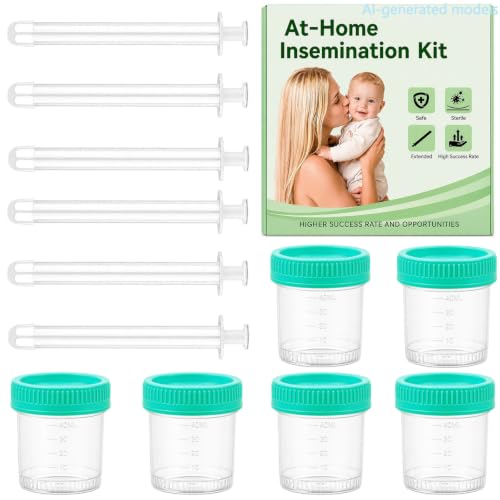
Better for those seeking higher trial convenience and privacy. This six‑pack provides six applicators and six 40 ml cups, designed to extend reach beyond standard products. The sterilized, BPA‑free components are ready to use, aiming to align with a tighter ovulation window. Caution: extended reach may still require careful alignment for best results, and this set focuses on trial quantity rather than premium materials.
- Extended applicators for better reach
- Six‑sample set supports multiple attempts
- Ethylene oxide sterilized and packaged
Dompook At-Home Insemination Kit

Best all‑round option for beginners. This kit provides a complete at‑home insemination setup with a comfort‑grip syringe, a gentle rounded tip, and an extended barrel for precise sperm placement. The included spill‑proof cups reduce waste during transfer. Choose this if you want a straightforward, affordable entry kit with clear, user‑friendly components. Limitation: data does not specify clinician‑grade materials beyond general sterile claims.
- Complete at‑home insemination kit
- Comfortable placement and extended reach
- Leak‑proof cups to minimize waste
Airivio At Home Insemination Kit

Best for sterile materials and leak protection. Airivio emphasizes clinician‑influenced design with a comfort‑grip applicator and a leak‑proof collection cup to minimize sperm waste. The kit is developed with fertility specialists to support safe at‑home conception. Caution: while materials are medical‑grade, ensure proper sterile technique and avoid contamination during handling.
- Sterile, medical‑grade materials
- Comfort‑grip applicator for precise placement
- Leak‑proof cup with a stable base
Mosie Baby Insemination Kit

Best for FDA‑cleared at‑home use. The Mosie Baby Kit is the first FDA‑cleared at‑home intracervical insemination kit, designed for ease and privacy. It supports conception attempts with straightforward instructions and is marketed as accessible for private use, including potential FSA/HSA eligibility. Caution: ensure you follow all instructions precisely and confirm eligibility if using reimbursement channels.
- FDA‑cleared syringe kit
- Designed for use with fresh or donor sperm
- Accessible and budget-friendly option
Buying Guide
What to consider when choosing an at‑home insemination kit
Key factors include syringe design for comfort and control, reach of the applicator, and the effectiveness of sample transfer. Look for extended barrels that help place sperm at the correct depth, and leak‑proof cups that minimize waste during transfer. Materials should be medical‑grade and BPA‑free to reduce contamination risk. If you have privacy needs or budget constraints, consider a multi‑pack option that enables multiple attempts within a single ovulation window.
How to compare kits more effectively
Compare based on: applicator grip and tip comfort, extension length, cup leakage protection, sterilization method, and whether the kit is clinician‑informed. Kits that include clear instructions and safety features are generally easier for first‑time users. For ongoing support, select products that offer straightforward return policies or documentation to guide proper usage.
Practical tips for at‑home insemination
- Record ovulation timing to maximize the 24–48 hour fertile window.
- Prepare a clean, private space to reduce stress and contamination risk.
- Follow each kit’s specific instructions for sample handling and placement.
- Use the leak‑proof cups to minimize sample loss during transfer.
- Consult a healthcare professional if conception does not occur after several attempts.
FAQ
- Q: Are these kits safe for home use? A: They are designed for at‑home conception with sterile, medical‑grade materials and clinician‑influenced design. Always follow instructions carefully.
- Q: Can I use donor sperm with these kits? A: Some kits support donor sperm use; confirm compatibility with your chosen kit’s guidelines.
- Q: Do these kits require a prescription? A: Most are over‑the‑counter; however, check local regulations and product details.
- Q: What is the best kit for beginners? A: Kits with clear instructions, comfortable applicators, and leak‑proof cups are typically best for first‑time users.
- Q: Do these kits come with guarantees? A: Warranty and return policies vary by seller; review product pages for specifics.
- Q: Are these kits clinically tested? A: Some kits are developed with fertility specialists and have FDA clearance where applicable; verify each product’s claims.